Overtime calculator with state rules
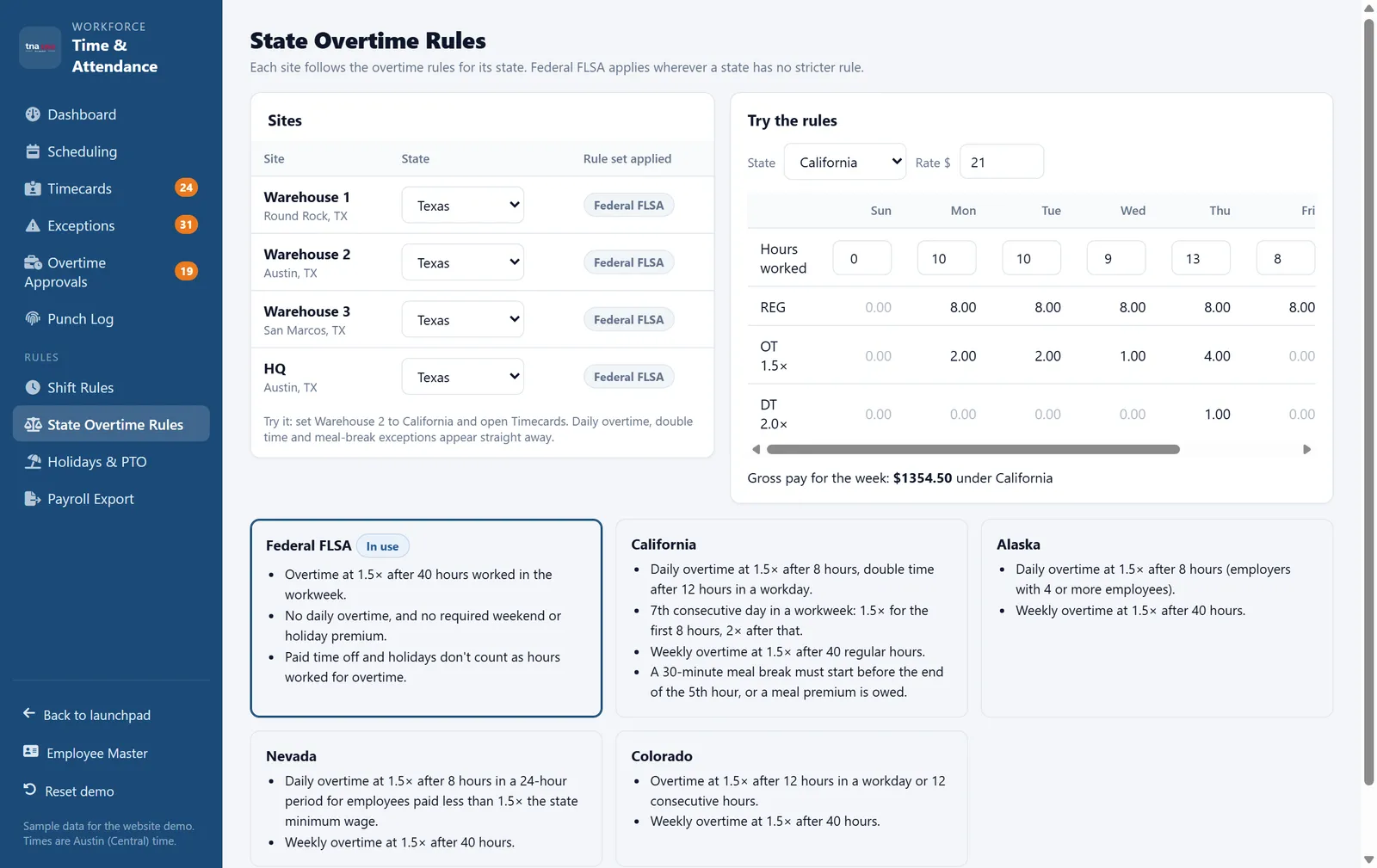
Enter a week of hours and an hourly rate. We split it into regular, overtime and double-time hours under the federal FLSA, or your state's daily overtime rules, and estimate gross pay.
Your workweek
Your result
| Day | Hours | REG | OT | DT | Pay |
|---|
This calculator gives an estimate for one workweek at a single hourly rate. It does not include bonuses, commissions or shift differentials (which can change the regular rate), exemptions, union agreements, public-sector rules, local ordinances or alternative workweek schedules. It is not legal advice.
Where daily overtime applies
Every state follows at least the federal FLSA rule of 1.5× after 40 hours in a workweek. A few states add daily overtime on top.
| State | Daily overtime | Weekly overtime | Other rules |
|---|---|---|---|
| Federal (FLSA) | None | 1.5× after 40 hours | No required weekend or holiday premium. PTO and holidays are not hours worked. |
| California | 1.5× after 8 hours, 2× after 12 hours | 1.5× after 40 hours | 7th consecutive day in the workweek: 1.5× for the first 8 hours, 2× after 8. |
| Alaska | 1.5× after 8 hours | 1.5× after 40 hours | Applies to employers with 4 or more employees. |
| Nevada | 1.5× after 8 hours in a 24-hour period | 1.5× after 40 hours | Daily overtime only for employees paid less than 1.5× the state minimum wage. |
| Colorado | 1.5× after 12 hours | 1.5× after 40 hours | Also 1.5× after 12 consecutive hours, even if they span two workdays. |
Stop calculating overtime by hand.
TNA-USA applies these rules to every timecard, for every site, as punches come in from your time clocks. Supervisors see overtime coming before the week is over, and payroll gets the split already done.
-
✓
Rules per siteEach site follows its own state's rules, so multi-state employers do not need separate spreadsheets.
-
✓
Overtime approvalsSupervisors see and approve overtime as it happens.
-
✓
Payroll-ready exportREG, OT and DT hours export straight to your payroll provider.
Overtime questions, answered
How is overtime calculated under federal law?
Under the Fair Labor Standards Act, non-exempt employees must be paid at least 1.5 times their regular rate of pay for every hour worked over 40 in a workweek. A workweek is any fixed, recurring period of 7 consecutive days (168 hours) that you set; it does not have to be Sunday to Saturday.
Which states have daily overtime?
California, Alaska, Nevada and Colorado have daily overtime rules. California requires 1.5 times the regular rate after 8 hours in a workday and double time after 12 hours, plus a 7th-consecutive-day rule. Alaska requires overtime after 8 hours a day for employers with 4 or more employees. Nevada requires it after 8 hours in a 24-hour period for employees paid less than 1.5 times the minimum wage. Colorado requires it after 12 hours in a workday or 12 consecutive hours.
Do paid time off and holidays count toward overtime?
Under federal law, no. Overtime is based on hours actually worked, so paid holidays, vacation and sick time do not count toward the 40 hours unless your own policy or a union agreement says otherwise.
Is overtime required on weekends or holidays?
Not under federal law. The FLSA does not require extra pay for weekends, holidays or nights unless the hours push the employee past 40 in the workweek. Some states, contracts and policies add premiums.
Can an employee agree to give up overtime pay?
No. Non-exempt employees cannot waive their right to overtime under the FLSA, even voluntarily. An employer can discipline an employee for working unauthorized overtime, but must still pay for the hours worked.
Do salaried employees get overtime?
Being paid a salary does not by itself make an employee exempt. To be exempt from overtime under the federal rules currently enforced, an employee generally must be paid a salary of at least $684 per week ($35,568 per year) and perform qualifying executive, administrative or professional duties. Several states, including California, New York and Washington, set higher thresholds.
Works with the rest of the platform
Every module shares one employee record, one set of time clocks and one login.
Let TNA-USA do the overtime math on every timecard.
See federal and state overtime rules applied automatically to real punches from your time clocks.